interior/exterior landscape dialogues in site-situated choreographic compositional practices:
an investigation of a creative process
VIRGINIA FARMAN: WEBSITE IN SUPPORT OF PHD BY PUBLICATION THESIS
OCTOBER 2024
I am a site-dance choreographer and researcher working in live performance, artist-film production and dance research. My practice engages with questions of human-environment relations in urban and rural settings where I work with trained, untrained, disabled and intergenerational groups of dancers. This PhD thesis establishes an argument for the particular ways that my practice cultivates connections between people and places.
CONTACT: v.farman@chi.ac.uk
ABSTRACT
This thesis reflects on the processes employed to investigate interior/exterior landscape dialogues from a practitioner-researcher perspective in the making of five site-situated choreographic productions: Tandem Ballet (2012), Everyday Hero (2013), Dances on Street Corners (2016-19), Children’s Games (2019), Souvenir (2020), and two dance for camera works-in-progress, (Dances with) Clouds, Gate and Tree (2020) and Sketches in Reel Time (2023).
As a collection, these published works reflect the ways that my practice develops and engages site-dance methods to cultivate embodied connections between dancers’ interior perceptions and exterior urban and rural spaces. The term interior/exterior landscape dialogues is employed to refer to the quality of the dialogic exchange developed through improvisational and compositional dance processes that critically engage with ideas from a range of theoretical discourses including phenomenology, spatial theory, anthropology and aesthetics, whilst also referencing selected examples from professional dance, visual art and film practice. More broadly, the research is related to the fields of human geography, architecture, environmental humanities and site-based performance.
The written thesis articulates the ways that notions of embodiment, expression, wildness, correspondence, and agency have informed and are addressed in and through practice to explore and reveal body-site reciprocity in performance. To establish this, the thesis argue that the published works demonstrate ways to engage and employ the affective and agentive potential of the site as a dynamic aspect of choreographic form. This has led me to describe my practice via the term, site-situated.
The understandings gained through the study are articulated through the development of methods that demonstrate the particular ways that my practice cultivates embodiment in dancers, and creative approaches that can be of value to contemporary site-dance practitioners, researchers and educators. Furthermore, the thesis proposes that through the development of this practice new readings of site, space and place are configured as personally constructed exterior spaces that enable interior, multiple and more-than-human perspectives to emerge.
The written thesis is accompanied by this web-based archive that documents the practical performance outputs.
INTRODUCTION
The research examines my site-responsive choreographic practice from a practitioner–researcher perspective in five recently published works, Tandem Ballet (2012), Everyday Hero (2013), Dances on Street Corners (2016-19), Children’s Games (2019), Souvenir (2020) and two dance for camera works, (Dances with) Clouds, Gate and Tree (2020) and Sketches in Reel Time (2023). Reflecting on these projects, I retrospectively examine how interior/exterior landscape dialogues were developed, considered and pursued and I analyse their significance to an evolving site-dance discourse (Kaye 2000, Pearson 2010, Tompkins 2012, Hunter 2015, Smith 2019).
The term interior/exterior landscape dialogues applied in this research refers to the quality of dialogic exchange between internally felt perceptions and external, topographical landscapes.
In the written thesis, I reflect on the choreographic processes employed in various ways in each project, to cultivate body-site engagements in dancers. The notion that choreographic processes can investigate and articulate perceptions of space and place is theoretically underpinned by assertions from phenomenology that subjectivity and spaces and places are co-constituted (e.g Merleau-Ponty, 1962,1968, Sheets-Johnstone 1966, 2009; Farleigh, 1987, 1991, et al). From a different theoretical perspective but also relevant to the research, is philosopher and sociologist Henri Lefebvre suggestion that subjectivity and constructions of space are ‘inextricably bound’ together and are perceived both internally as felt-experiences and externally as physical, architectural, historic, social and cultural structures that evolve as much through the development of their material as through cultural and intellectual exchanges (1996:35).
In the written commentary on my own practice, exterior spaces are considered as a nexus of multiple, coinciding narratives, tempos and rhythms and body-site relations are approached in the light of the proposal from spatial theory where bodies and spaces become-together to temporarily produce places of personal significance (Bachelard,1964, Lefebvre,1991, 1996, De Certeau, 1984, Hunter 2015, et al).
CLICK ON IMAGES TO VIEW CONTENT

Tandem Ballet & Everyday Hero
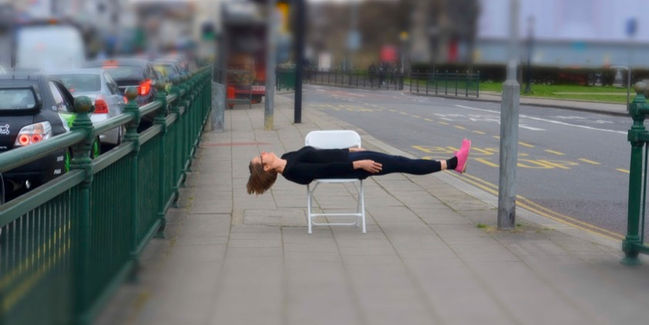
Dances on Street Corners

Children's Games

Souvenir

(Dances with) Cloud, Gate and Tree and Sketches in Reel Time